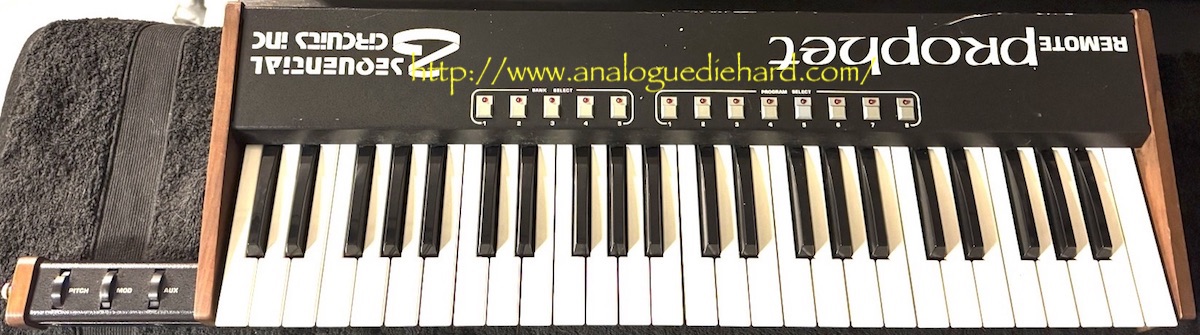
SCI Prophet Remote "Keytar"
Update: 03/01/2026
Sequential Circuits (aka SCI) back in 1980 was riding high on the
success of the Prophet 5 polyphonic analog synthesizer. The Prophet
went through several firmware and circuit revisions. When one of
their last revisions was released in 1981, they introduced the
optional polyphonic sequencer and Remote controller. The model 1001
Remote is a keyboard designed as a remote "keytar" controller for
the Prophet-5, and it only works with a rev 3.2 or 3.3 model.
Earlier Prophet-5 revisions cannot be retrofitted to use the Remote
because the processor circuit board does not have the support
circuits.
The Remote was not a MIDI controller; about 300 of them were made
before production of the Prophet-5 ended. SCI had never developed a
proper MIDI implementation for the Prophet-5 or Prophet-10. A 20
foot hefty interface cable connected the Remote to a Prophet-5 (an
optional 40 foot cable was available). The 49 note keyboard was not
velocity sensitive, three modulation wheels were provided (the pitch
wheel is spring loaded but unipolar only bends up), and there were
buttons to select any of 40 programs on the Prophet-5 (on a model
with 120 programs, you still only had access to the first 40). The
3rd wheel was labeled AUX.
This one showed up on an auction site and I won the item as the only
bidder. I do not own a Prophet-5. So why did I buy it?
- I intend to remove the original circuit board and shoehorn a
MIDI retrofit.
- It's a nice low profile controller that sits neatly on top of
my Hammond
XK3 in my stage rig.
- I'm not sure that I can revive my broken Lync LN1000
Keytar, so this will be an easier project.
- Almost every other "keytar" product is uncool. They look nerdy
and I refused to be seen with them.
- Almost every other "keytar" product includes on-board sounds,
which I do not want. I only want a MIDI controller that will
control sounds I have already developed.
- Most "keytar" keyboards are too short. A 49 note keyboard is
the minimum I will use.
- I like the feel of the old Pratt-Read keybeds on 1970s and
1980s synths. I never liked the feather light feel of modern
keybeds.
The Remote used both the rear panel digital jack and analog jack on
the rev 3.2 & 3.3 Prophet-5, and there is a hefty 10 pin
connector at the Remote end. This all pre-dated MIDI. The analog
jack provided power to the Remote, and received the CVs from the mod
and pitch bend wheels. The digital jack was the digital interface
for key data and program select - this used the USART on the
Prophet-5. The AUX wheel terminates at a 1/4" TS plug, where it
could plug into either the rear panel filter jack (filter sweep) or
amplifier jack (volume control). That hefty cable carried digital
signals, analog CVs, and power rails.
An EPROM loaded Intel 8748 microcomputer receives system clock and
serial data from the Prophet-5, handles scanning the keyboard and
program buttons, and transmits serial data. While the Remote is a 49
note keyboard, the schematic reveals provision for a five octave 61
note keyboard. Maybe this was an option on the drawing board but was
never produced. Reviewing the format of the serial data, it is not
far from what would become MIDI. The difference is that the Remote
constantly sends serial keyboard data, rather than only when an
event change occurs. Also while MIDI digital I/O is a current loop,
the Remote I/O is a single wire voltage domain. The advantage of a
current loop is that it does not require a ground reference, which
eliminates ground loops.
On its own, the Remote is useless without a Prophet-5. The original
circuit board is not suitable to convert to MIDI operation.
Reprogramming the 8748 is not a great proposition in that
development systems are no longer available, and 8748 compiler
software options are limited. I'm not sure if the security bit is
asserted on the 8748, which prevents reading or writing the EPROM
space (although this 8748 does have the window for erasing the
EPROM). I have some Intel 87xx databooks stored in the garage, there
might be info there. The 8748 has no analog voltage inputs, so the
wheels cannot be interfaced.
So I intend to remove the original circuit board and retrofit a
Highly Liquid MIDI-CPU MIDI interface (sadly no longer made) for the
keyboard and the wheels. I'm not sure if the switches can be
implemented with the retrofit, I have to study the Highly Liquid
document some more. I don't need provisions to change the MIDI
channel or transpose, that's what my JL
Cooper MSB+ is for. Ditto with MIDI program change, that's
what my Kurzweil
MIDIBoard is for.
I was successful with a similar
retrofit
on my Moog Taurus II bass
pedals. At the moment this project is not a priority, so check
back later for updates!

Home