Moog Minimoog Voyager analog monophonic synthesizer

voyager-se-1
voyager-rear-pamel
voyager-rosewood
prototype-2000
voyager-se-2
voyager-rear-panel-flat
voyager-select-backlight
prototype-2002
voyager-rme-tabletop
voyager-rme-rack
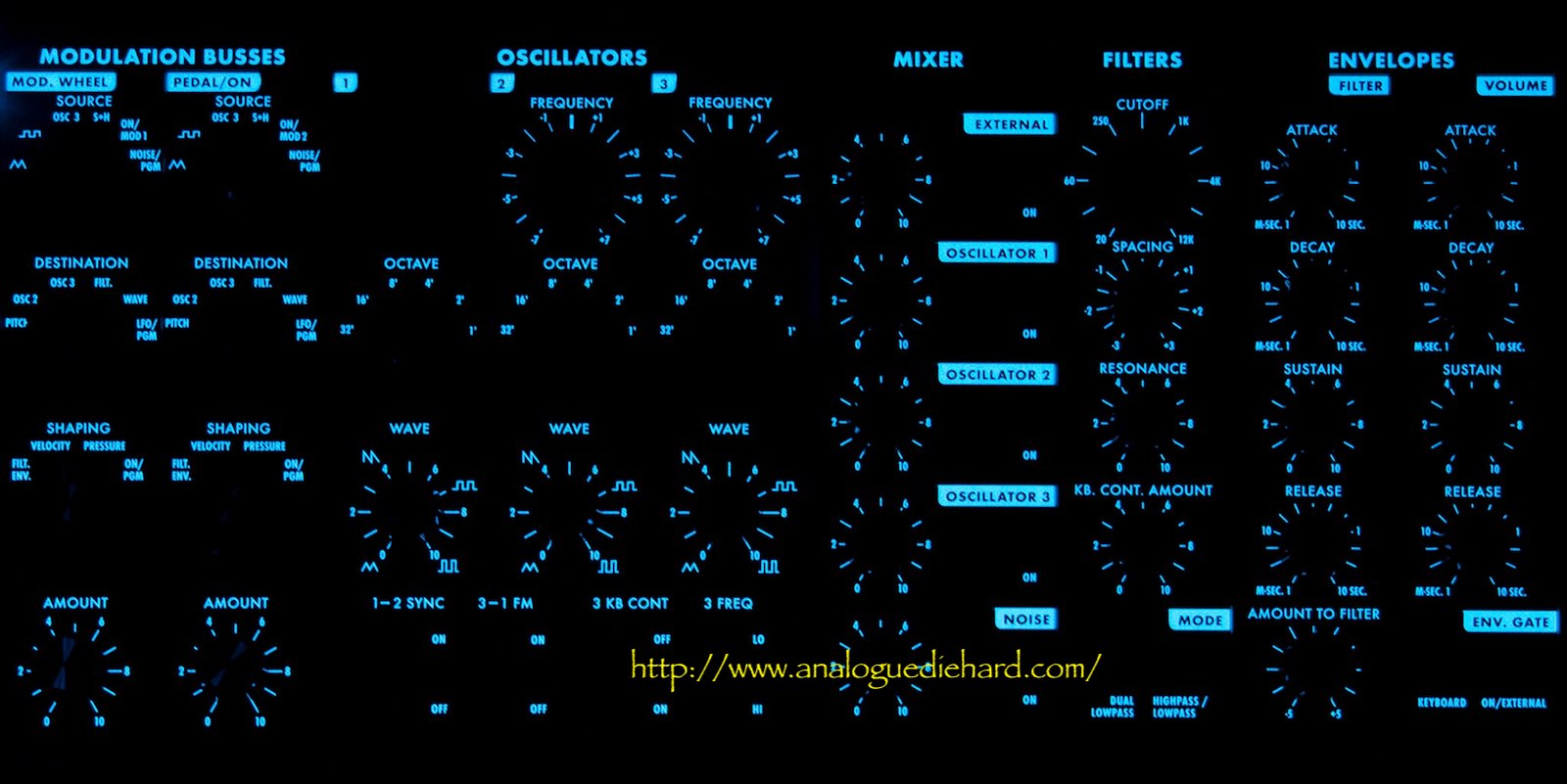
voyager-backlight
gift-brass-knob

Last Update 05/03/2026


Does it Sound like a Minimoog?
Firmware
Features
Production Variations
Faulty Components
Faulty Tuning
Sounds Models
Epilogue

Back in 2000, I was in Los Angeles CA with Audities setting up all these cool old vintage synthesizers for a special display for the Museum of Technology at the NAMM show, which was the first one I attended. It was the night before the show opened. Bob Moog (RIP) stopped over to admire our work. I introduced myself and he remarked "I remember you" (I had met Bob four years prior - he had a GOOD memory). When we finished, we sought out Bob at his Big Briar booth (Big Briar was the name of his business before he won back the Moog Music trademark). Bob had been promising a new modern Minimoog. My partners in crime sought out the latest Moogerfooger pedals, while I made a beeline towards Bob who was showing his new keyboard to his associates. As I peered over their shoulders to get a look I said "Is that the new Minimoog?!?"

Bob was not happy when he saw me, so he pulled the cover back over the keyboard and hid it under the table. Realizing my awkward intrusion, I quickly regained my composure and apologized. "Tomorrow", Bob promised with the smile returning to his face. Looking back, I couldn't blame him for being secretive - Minimoog clones had been built by other companies and they had yet to reproduce that "Minimoog" sound that was so elusive. The analog renaissance that started in the previous decade was in full swing and the market value of vintage Minimoogs were steadily climbing. But the Minimoog was a 1970 design and by the year 2000 players had longed for a programmable Minimoog that had MIDI and expanded features. Bob was poised to deliver and - rightfully - he didn't want to blow his chance. While Bob was the primary designer of the Minimoog back in 1970, he left Moog Music in 1978 over frustrations with the Norlin corporate atmosphere (who then owned Moog Music) and with his departure he lost the right to use his birthname on his instruments (he would later reclaim the trademarks for Moog and other famous Moog instruments, but that's a subject for another webpage). Bob knew how to build what customers were asking for, and he wasn't about to repeat mistakes from thirty years ago.

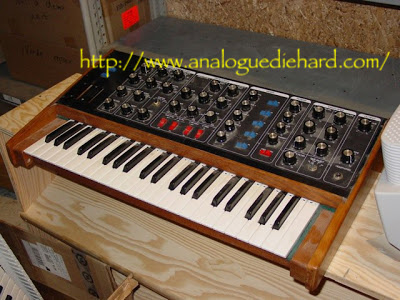
The NAMM show opened the next day and we received many enthusiastic visitors to our Technology display. When I was offered a break to browse the show, I stopped by Bob's booth to get another look at the new keyboard. It was his prototype Minimoog for the 21st century (shown at top right image), but not the familiar Voyager layout. It did not yet have the LCD interface, the hinged panel, or any controls to suggest programmability - clearly a work in progress. The circuits weren't yet fully operational so it wasn't making sound.

The year before, Bob had covertly sent a poll to the Analogue Heaven list - the largest collective of analog synthesizer users at the time - asking what features customers would like to see in a 21st century Minimoog. I knew it was Bob when David Kean of Audities phoned me to alert me of the poll in progress (I was away on a distress call at home). Shortly after I submitted my input to the poll, it was closed to further comment. Whew, barely made it! Seeing the prototype was progressing in the direction I had desired, Bob took down my name as a definite customer.

I worked at the NAMM show the following year, but no keyboard in sight at the Big Briar booth. That year, a naming contest was held for the new synthesizer - "Voyager" was the winner. By 2002 (which I had not attended) Bob showed a new prototype (shown at top right middle image), much closer to the finished product. It now had the hinged panel, the LCD interface, and programmability. It was largely ready except for the three dimensional touch surface. The touch surface was supplied by a third party called Tactex, and its optical interface presented difficulties that ultimately proved insurmountable and it was later replaced by a touch surface of Bob's design ten years prior, a standalone product at the time. Firmware development was delayed due to the changeover of the touch surface, so on initial release it was rudimentary. By that spring, Bob had re-acquired the trademark of his name and renamed Big Briar to Moog Music. By that summer, preorders were being accepted for the new Minimoog and I eagerly placed an order. By that fall, production started and soon I had a Minimoog Voyager Signature Edition in my hands. Wow what a beast... walnut case with brass badge. The first 600 Voyagers were Signature Editions (SE) which could be ordered in walnut, cherry, or maple cases. Each one was personally signed by Bob on a black box to the left of the LCD and included a certificate of authenticity. Back then, Voyagers were purchased direct from Moog Music - retailers were very late to the analog synthesizer renaissance and had not yet included analog synthesizers on their shelves or websites.

While the official product name is "Minimoog Voyager" (the badge on the left is stamped that way), for this discussion it will be referred as "Voyager" and the vintage Minimoog referred as "Minimoog". top

Does it sound like a vintage Minimoog?

There were many people anxiously awaiting word about the new Voyager... can it sound like a Minimoog? Yes it can! As an owner of an early RA Moog Minimoog (RAM), I had a prime specimen to compare against. I had six other Moog synths that could not reproduce the G-R-O-W-L that the RAM does. Nor any of my other vintage synths. I finally succeeded in nailing that elusive G-R-O-W-L on the Voyager. If anybody could match or beat the Minimoog sonority, it had to be the man who built them in the first place.

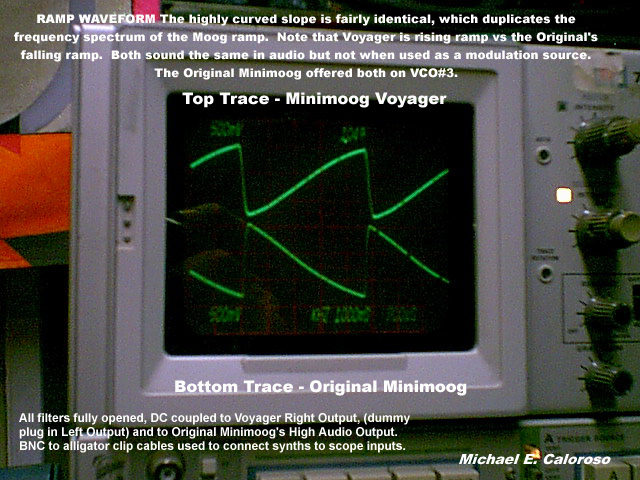
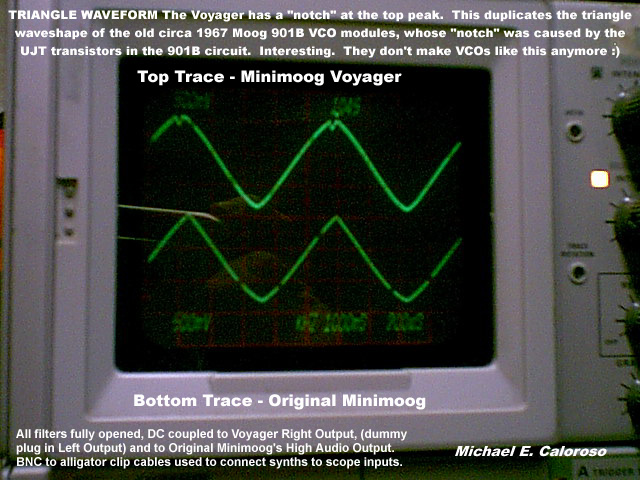
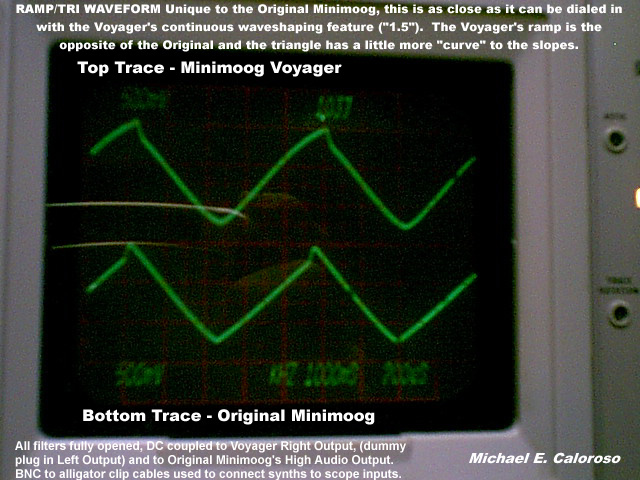
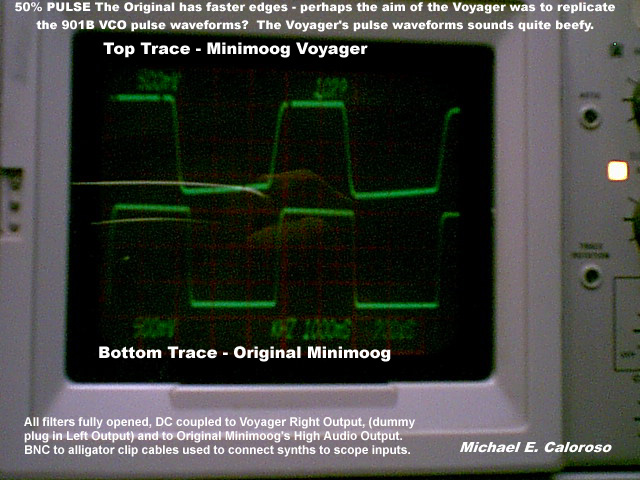
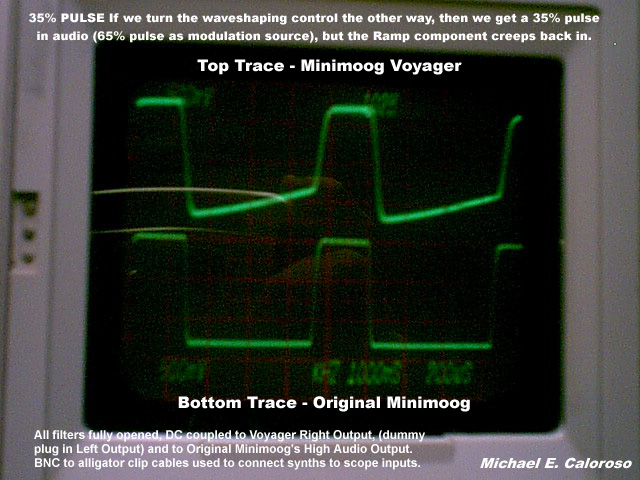
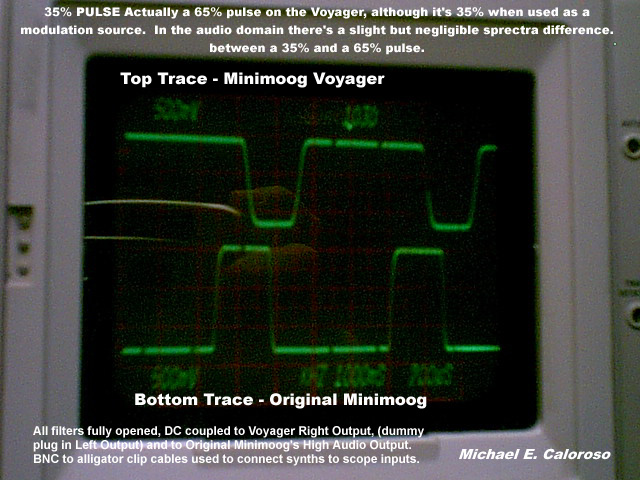
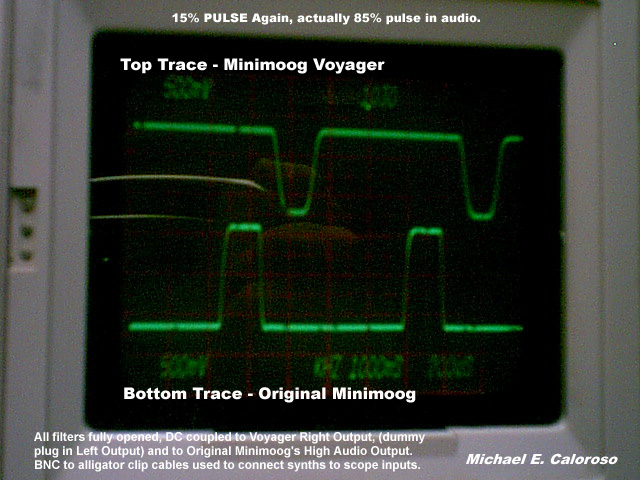
I examined Minimoog and Voyager waveshapes on my oscilloscope, varied the Waveshape control on the Voyager to emulate that of the Minimoog, then took pictures of the scope traces which are shown below. Flat or gradual sloped traces on the pulse waveshapes are inaudible DC or subsonic frequency. The promotional material for the Voyager claimed that the oscillators were designed to emulate the original 901B VCO module of the early Moog Modulars, whose "quirk" in the triangle waveshape is true to the 901B. They even emulated the slower rise/fall transitions of the 901B pulse waveshapes. Once the Voyager Waveshape control was adjusted to visually match that of the Minimoog, listening to both revealed very little sonic difference.

Ramp Waveshape
Triangle Waveshape Ramp+Triangle Waveshape
waveshape-ramp
waveshape-triangle
waveshape-ramp-triangle

50% Pulse Waveshape 35% Pulse Waveshape 65% Pulse Waveshape 15% Pulse Waveshape
waveshape-pulse-50
waveshape-pulse-35
waveshape-pulse-65
waveshape-pulse-15-85


While the VCO waveshapes and filter are a dead on ringer for a Minimoog, eventually some people noticed that if you opened the filter all the way the Voyager didn't have the high end "sheen" of the Minimoog. My suspicion zeroed in on the VCA, which had long been overlooked as a contributor to the Minimoog sonority.

VCA fidelity when the Minimoog was designed in the late 1960s was pretty poor, and distortion and noise were a necessary evil. The VCAs in a Minimoog (there are two) were not high fidelity low distortion audio devices, in fact if you pump CD material through a wide open Minimoog filter that program material will sound terrible. That was the best that 1960s technology had to offer at the time. In fact, the VCA was a simple differential amplifier right out of an EE college textbook. As technology advanced through the years VCAs got cleaner and quieter. The signal path in the Minimoog is driven a bit hot, driving the VCAs into subtle distortion and creating that creamy fat sound that we all know and love. This hot signal was a design error not spotted until they were well into production at the RA Moog works, but in their wisdom they left it intact (imperfections can be a good thing).

What emulators missed out is the distortion of the classic VCA which is a direct contributor of that "vintage sound". To make things more fun, the distortion was dynamic depending on how hot the mixer levels were. And the Minimoog had a pair of these "dirty" VCAs, doubling the distortion fun. The EMEAPP group, along with analog experts and design engineers from the original RA Moog/Moog Music days, uncovered that there were THREE variations of VCA circuits throughout the the Minimoog production cycle. And each VCA circuit had its own peculiarities with dynamic distortion! Modeling dynamic distortion in softsynths is a big challenge because the exact mathematical model is not easy to derive and it is a major number cruncher to implement on a microprocessor (it's not just an inverse tanh curve). The challenge to modeling VCA distortion is that it varies with the frequency spectrum (IE triangle vs ramp vs all variations of pulse width) and how hard you drive it. The original Minimoog VCAs were discrete differential transistor circuits right out of EE textbooks. These circuits are neither high fidelity or low noise.

As technology advanced, VCAs got quieter and cleaner. Great for automated mixing consoles... but Tom Oberheim was one of the first to notice that something was missing in his synthesizers. Oberheim had released the OB-8 which used the clean quiet CEM3360 for the VCA in the voicecards. Older designs used a CA3080 OTA followed by a buffer opamp, which had a dirtier sound. While the CEM3360 was cheaper and simpler, Tom objected to the OB-8 being "too clean" and the VCA was reverted back to the crunchier OTA/opamp design.

Well, Bob made a similar goof in the Voyager (hey we're not perfect). The VCAs in the Voyager used the 13700 OTA which is an "improved" CA3080 - it was actually the CA3080 core with a predistorter on the input and a Darlington buffer on the OTA output (the CA3080 core has a pretty weak output current source). Both these additions were intended to reduce distortion and improve signal-to-noise ratio. Soooo... the 13700s in the VCA in the Voyager were configured as a "CA3080" without the predistorter or the buffer; while it had its own distortion characteristics, it wasn't as dirty as the primitive differential amplifiers in the Minimoog.

I was able to confirm that the Minimoog VCA was the contributing factor by routing the Voyager MIX output (after the filter, before the VCA) to the Minimoog external input which put the Voyager through the Minimoog VCA and - wala - instant Minimoog "sheen" on the Voyager. The Voyager VCAs are too clean!

So we were kind of stuck with the "polite" VCAs in the Voyager... until another solution designed by Rudi Linhard (who partnered with Bob on the Voyager and developed the firmware) became known as the "Slew Rate Mod". This was an upgrade available to Voyager owners and I had it installed in my SE unit. It removed some components and substituted some opamps with different ones. According to Rudi, he noticed that certain circuits "tamed" the sound but Bob did not want to correct them. We do not know Bob's reasoning, perhaps someday someone will unearth Bob's notebook (he kept meticulous notes) and learn of his preferences. In any event, Rudi's mod was an audible improvement which brought back the "sheen" to the Voyager. Moog Music no longer performs any modifications or maintenance for the Voyager, but the circuit changes and schematics are in the hands of various repair techs. The Slew Rate Mod was not implemented in the production line, and there isn't anything visible to identify if the mod is intact. You have to inspect the analog circuit board inside and know what components were changed. top

Firmware Changes

The Voyager has progressed through many firmware changes - some that fixed bugs, some that added new features, some that "turned on" hardware circuits.

Rudi Linhard developed the firmware for all the Voyager models. The firmware resides in four MIDI sysex files - Bank A (System), B (Boot), C (System), and D (System). Depending on version, some or all banks must be loaded. Release notes contain installation instructions and addendums to User Manuals. If the bank(s) aren't listed in the table below, it's because I don't have the installation instruction for that version. Not every version iteration was released, IE version 2.2 isn't listed because they skipped it.

Save your patches before upgrading firmware! Some releases change or erase the patch data, thus after the upgrade your patches must be re-loaded.

RME model firmware is not the same as keyboard models. I don't know the serial number or all dates when new versions were implemented in production.

Check your current OS version before upgrading firmware - if your unit does not have the "Required Minimum Prerequisite Version" then you must load that version before the one you are upgrading.

The firmware changes for models with keyboard are tabulated in this table (TS=Touch Surface, AT=Aftertouch):

Firmware Version
Required Minimum
Prerequisite Version
Date Released
Sysex Banks Bug Fixes/New Features
3.6 (final - beta)
1.5
3/29/2017
B, A, C, D
  • Fixed MIDI In Velocity bug
  • Fixed TS A axis bug
  • MIDI Enable
  • MIDI Clock Output
  • Selectable MIDI CCs for ENV Gate foot switch
3.5
1.5
1/27/2010
B, D, A, C
  • Active in production 2/3/2010
  • Send MIDI Panic when MASTER menu is opened
  • Eight Glide modes
  • "Quick Save" function
  • Sound Category Browse
3.4
1.5
6/23/2008
B, A, C, D
  • Reset MASTER/PANEL menus to factory settings
  • Global reset of selected parameters in patches (Category, Pitch Bend, Pedal Amt, TS LFO S&H)
  • Control of LFO S&H from TS
  • Enhanced pot resolution during multiple pot manipulations
  • Local ON/OFF for keyboard, wheels, AT, TS, Pots, Switches
3.3
1.5
2/22/2007

  • Local ON/OFF for panel controls
  • MIDI Key Order for polyphonic playing using multiple Voyagers (three max)
  • Easier save operation to the seven banks
  • Up/Down amounts for Pitch Bend Wheel stored in preset
3.1
1.5
11/19/2005
B, A, C
  • Fixed RECALL function bug
  • Improves SAVE PRESET routine
3.0
1.5


  • Memory expansion 7 banks of 128 patches (also works with original single bank)
  • Memory expansion requires replacement Processor board
  • "Quick Mode" Ext Audio Pot can function as scroll control through patches
  • Mod Wheel can send 7 or 14 bit MIDI CCs
  • Reduce MIDI data sent from TS
  • new menu item REAL PANEL PARAM sets new patch from panel settings
  • new menu item LCD CONTRAST
  • MIDI Running Status
2.5
1.5
10/11/2004
B, A, C
  • Sends panel sysex transfer with real pot values unaffected by Pot Mapping or TS.
2.3
1.5
8/9/2004
B, A, C
  • Fixed bug when changing presets in PANEL mode between presets 53 and 55
  • Recognize SysEx dump request - whole bank or individual presets
2.1
1.5
4/12/2004
B, A, C
  • if upgrading from v1.5, initialization of new patch features in old patches
  • Recall lost sound - recalls last edited sound after changing patch
  • renamed parameters in some menu items
2.0
1.5
3/4/2004
B, A, C
  • Pot Mapping - internally maps front panel control(s) to any of 40 destinations
  • Pot Mapping depths are fixed 0/25/50/100%, Mod Busses are variable.
  • Mod Busses are unipolar (positive only), Pot Maps are bipolar (positive and negative modulation)
  • Mod Busses have shapers, Pot Maps do not.
  • Transmit MIDI outputs of TS, AT, Wheels
  • MIDI In/Out on/off
  • Keyboard transpose, key order, velocity curve
  • Configurable SysEx Device ID
  • Compare mode - saved preset vs panel edit
  • Pitch Bend amount per preset
  • Programmable Shaping sources
  • TS Gate destination / assignable MIDI CC for any axis and gate
  • Gate source for VCF and VCA EGs
  • Pitch Bend amount stored in preset
  • Use the Voyager keyboard as data entry device for naming preset
  • Reset patches to factory presets
  • Reset selected patch parameters for all patches
1.5

7/2/2003
B, A, C, D
  • Transmit/Receive MIDI CC values for panel pots/switches
  • Powers up in PANEL mode
  • Powers up with last edited patch
  • Menu items numbered by page/item for simplified navigation
  • +/- button scrolls when either is held down
  • MIDI Clock retriggers LFO when LFO Sync switch is set to MIDI
  • Local Keyboard on/off
  • Merge MIDI out data with MIDI in data
  • Disable reception of MIDI Program Change
  • "Send Panel Sound" same as "Send Single Preset" without patch number. Loads in edit buffer only.
  • Selectable cut slope of either filter - 1, 2, 3, or 4 pole (6, 12, 18, or 24dB/oct respectively)
  • TS destinations of each of three axis signals
  • TS memory - remembers X/Y positions when finger is lifted. Patch level or global.
  • LFO MIDI Clock Divider when LFO Sync switch is set to MIDI
  • Send system banks (A, B, C, or D)
  • Automatically detect which system bank is received
1.2

3/2/2003

  • Upgrade to v1.5 highly recommended
  • TS memory (global)
  • Fixed Master Volume
  • Fixed LCD Contrast
  • Fixed Glide bug when switched off
  • Fixed system crash when Parameter menu is loaded
1.0 (1st Release)

12/10/2002

  • Upgrade to v1.5 highly recommended

I will add the table for RME model later.

top

Features

ALL FEATURES DISCUSSED HEREIN ARE RELEVANT TO THE LATEST FIRMWARE VERSION 3.5

The Voyager can be integrated via CV with external synths and sequencers, so a modular can be a great asset. It also has a comprehensive MIDI implementation. If you desire to use the Voyager CV outputs to control other synths, you will need the optional VX-351 output expander accessory. If you have the RME model and desire to control it over CV from external synths and sequencers, you will need the optional VX-352 input expander (now hard to find).

For this discussion the modern synth will be referred as "Voyager" and the vintage Minimoog referred as "Minimoog".

The VCO->VCF->VCA signal flow and controllers (LFO, EGs, touch surface, wheels, aftertouch) are 100% analog in the Voyager. The front panel knobs are digitally scanned for programmability but the "stepping" is very low (I don't know what the bit resolution is).

Filters

The Voyager has two ladder filters: the resonant qualities are great, equal to the Minimoog and slightly better than the Moogerfooger MF-101 pedal. Having two filters with configurations of parallel dual lowpass in stereo left/right (LP/LP) or serial highpass into lowpass (HP/LP aka Bandpass) is a great improvement over the Minimoog. The highpass filter is not resonant and will not self-oscillate, but that's a petty omission not worth crying about. The Moog 904B Highpass module from the modular was resonant either. Both filters are the classic 24dB/oct Moog transistor ladder filter and they are independently selectable in 24/18/12/6 dB/oct responses.

The SPACING control varies the cutoff frequencies of both filters in either mode - the labels on the panel are scaled in octaves, so setting SPACING to +1 sets the cutoff of the left filter an octave above the right filter, whose cutoff is fixed to the setting on the panel. In LP/LP mode this creates two resonant peaks for unique timbres (using the touch surface x axis to sweep one filter while the Y axis sweeps the other filter is a wild effect). Altering the cutoff changes both filters at the same time. In HP/LP mode, the filters are in bandpass mode so the SPACING control varies the width of the bandpass response - at full clockwise it creates a very narrow bandpass filter. The effect this has in the stereo field has to be heard to be believed, and it is dynamic based on how much resonance is used. The front panel headphone jack is stereo so K-Mart shoppers should check out the stereo operation in lieu of a stereo monitor system. There's enough range to cover the spectra of any traditiona instrument, so it should be sufficient for new unheard sounds.

The Voyager filters are constant Q; the original Minimoog filter was not constant Q. The Minimoog filter resonance decreases at low cutoff settings. This is a subtle trick that has eluded synth makers and programmers. By "spiking" the Minimoog filter with a snappy fast attack/decay envelope generator to a zero sustain, the decreasing resonance as the envelope approaches zero sustain actually increases the low end bass. This is why the Minimoog has reigned king of the synth bass for years. Because the Voyager constant Q maintains its resonance over the entire cutoff range, it doesn't reproduce this trick.

The Minimoog labeled the Q control as EMPHASIS; the Voyager labeled it as RESONANCE, which is more logical.

Fear not, for there are two ways the Voyager can pull off the same trick. One is setting the resonance between 8 and 9 (on a scale of 0 to 10), the filters will self-oscillate but not across the full cutoff range as it will with the resonance cranked to 10. The second (for non self-oscillating patches) is by routing filter envelope to filter resonance using either the Mod Buss or Pot Mapping. I did that trick for a Minimoog patch on the Alesis Andromeda and it does make a difference.

When you crank the filter into self-oscillation, the Minimoog filter oscillation degrades at about 100hz while the Voyager dips into subaudio. I have subwoofers so I can definitely hear them go that low. The Voyager can nail the classic screaming leads, owing to the great VCOs and filters. If you want only one of the dual filters like the Minimoog, you can just put filter #2 in highpass mode and rotate the SPACING control all the way counterclockwise so it rolls off minimal subaudio, or you can insert a dummy plug in the rear panel right output jack while listening to audio through the left/mono jack. The filters have that vintage warmth and squeal (even better with the Slew Rate Mod), with a touch more cream in the resonance. A major improvement over the Minimoog is that the keyboard tracking is completely variable between zero and 100% - really handy with the HP/LP mode.

One feature overlooked on early Voyagers is that the keyboard tracking to the filters are not processed by the glide processor - a very important component of the Minimoog sound. Some years after I bought my SE I brought it to the Moogworks for some updates and we set about how to add the missing feature. It only took a couple of cuts to the circuit board and a handful of components that can be tack-soldered, and we accomplished our mission. The staff played with the modified unit and liked the effect enough that the modification became standard on production units.

The cutoff control is an oversize knob for easier fine tuning and real-time filter sweeps (I recommend using the touch surface for real-time filter sweeps so that you don't wear out the cutoff pot). The filters on the Minimoog did vary circuitwise over its production era, and during some eras the Minimoog filter sound varied from unit to unit. Thus some era Minimoogs were better at soft smooth timbres, others did better hard sounds. However, the first ~150 Minimoogs had a feature that set them apart - all the transistor pairs in the ladder filter were matched, versus only the top and bottom pairs in the later units. The test is to set the EMPHASIS to moderate level to increase the resonance. My personal Minimoog is one of the first 50. I have heard three other early Minimoogs with the same filter circuit and they all sounded alike despite each having different oscillator boards. When I played later Minimoogs, the difference in the filter resonance was very noticeable. Next to my early Minimoog, the Voyager filters sound spot on - a peek at the schematics revealed that all the transistor pairs in the ladder are matched.

Dual filters are the most fun I have had in years, especially when sweeping them with the touch surface. When you run the Voyager in stereo and play with the touch surface, the phase difference between the filters is dynamic and the sound moves in the stereo field. You can get formant vocal effects if you dial it right. I can't emphasize enough how excellent the resonant qualities of the Voyager are. The RESONANCE control has a nice linear response to it so it is easy to dial in the desired resonance.

Independent stereo delays really offer some aural fun - feeding S&H noises and modulating filter cutoff using the touch surface gets some wacky sounds in the stereo field. Especially with headphones. Add a sprinkle of VCO3 audio FM to the filter, stir with touch surface, serve warm, feeds for hours. If you thought a single delay on a single filter monosynth was fun...

Touch Surface

The touch surface (omitted on RME and OS models) is the rectangular pad below the LCD display. It is a three dimensional controller that responds to finger position (x and y) and finger area, and is a really fun controller for manipulating up to three independent parameters in real time. Look at the pad as a four quadrant two dimensional graph with an X axis and Y axis having zero origin at the center which is the junction of the axes. I make no apologies for reliving nightmare memories of high school algebra classes :) Assuming that the X axis is assigned to filter cutoff, when you move your finger to the right of the origin you're opening the filters; to the left, you're closing them. Assuming that the Y axis is assigned to filter spacing, moving your finger up and down changes the filter spacing. It's like having two extra hands changing cutoff and spacing at the same time.

I mentioned two dimensions - X axis and Y axis. The third dimension is finger area (not pressure), known as the Z axis. Picture in your mind a plate of glass between your face and your hand; gently touch the glass with your fingertip and you'll see a small portion of your fingertip against the glass. This is the area that the touch surface is sensing. Apply a little more force with the fingertip, and you'll see a larger portion of your fingertip flat against the glass - hence more AREA. While holding your fingertip on the glass, bend your hand down as to put your palm against the glass and you produce more area. This is not the same as pressure sensing.

Assuming that the Z axis is assigned to filter resonance, area sensing controls the filter resonance so now you got a third extra hand moving the resonance control. I have found that if you keep your thumb or opposite finger on the metal panel surface, the Z axis response is more sensitive. Best spot is right above the hinge on the bottom. The touch surface seems to react to hand capacitance to ground.

The touch surface allows you to modulate three assignable parameters with a single finger, all at the same time. Each of the axes are assignable to various destinations (stored with the patch) so you're not limited to just filter control. For each axis the modulation depth of each axis can be set to OFF/25%/50%/100%, a MIDI CC can be assigned, and the response can be inverted. The touch surface can also gate the envelope generators; combine this with sweeping oscillator pitch and filter and you have joystick control like the old EMS VCS3.

The touch surface controller was patented under US 4,778,951 listing Bob Moog and William Pepper as inventors and assigned to Peptek Inc. This 1988 patent predates the Voyager. William Pepper seems to have a fascination with touch controllers as he has various patents dating back to the 1970s.

Oscillators

Having the variable waveshaping on the VCOs in addition to those great filters really really helps to dial in a lot of sounds. There are three fully independent VCOs, two with detuning controls (+/- seven semitones) and all with independent controls for waveshaping, octave ranges from 32' to 1' (Minimoog octaves went from 32' to 2' plus a LO pitch), and mix levels with on/off switches. The tuning controls have oversize knobs for easier fine tuning. The Voyager's WAVESHAPE control continuously varies the waveshape from triangle to ramp to variable pulse - another big improvement over the Minimoog. The Micromoog/Multimoog also offered variable waveshaping but only between ramp and variable pulse. VCO3 can be set to low frequency mode for LFO duties and the keyboard control can be disconnected from VCO3 like the Minimoog. When keyboard control is turned off for VCO3, the detuning control has a wider range. The Voyager ramp waveforms are falling ramps; the only thing missing is rising ramp waveform which was available on VCO3 on the Minimoog for modulation (nothing to cry about as there is very little sonic difference between rising and falling ramp in the audio domain). One can produce a falling ramp LFO waveform by patching an external LFO oscillator in the rear panel mod buss input. Or configure the filter envelope generator as an LFO by gating it with the S&H and using pot mapping to route LFO RATE to either filter attack (for rising ramp) or filter decay (for falling ramp), then use the Mod Buss to route the EG to a destination. This creates a looping envelope generator that can serve as an LFO. This way, when you rotate the LFO RATE pot it also changes the rise or fall time in the EG - presto an LFO with rising or falling ramp waveshapes.

As revealed by the "Does It Sound Like A Minimoog" section above, the triangle waveshape has a "notch" in the top peak. This duplicated the 901B VCO "notched triangle" in the modular, which is caused by the old UJT transistor in the reset circuit. It adds a little edge to the mellow sounding triangle. They don't make VCOs like this anymore.

Even the highly curved slope of the Minimoog's ramp waveform is duplicated in the Voyager. I'd say that this makes up for the omission of the falling ramp from the Minimoog VCO3. The rising and falling edges of the Voyager pulse waves are not as fast as the Minimoog, but they are closer to the old 901B pulse waves. Variable pulse width waveshapes are a big improvement over the three fixed widths in the Minimoog; at extreme setting the pulse width is about 5% and you can drive it into zero pulse with the mod buss.

What about the combination triangle/ramp waveform on the Minimoog? The closest to the Voyager is dialing the waveshape at "1.5". Well, on the 'scope they don't look the same but in audio they SOUND the same.

Bringing the Voyager into the 21st century are hard sync and VCO FM. VCO2 can be hard sync'd to VCO1, and VCO3 can FM mod VCO1. The FM is linear which is the same used in the Yamaha FM system licensed from John Chowning (the patent is now expired). I found that exponential FM can be achieved through the Mod Buss. Hard sync works great for leads and bass, but it doesn't scream like the Moog Prodigy or Source. I have slap bass patches on my Source using hard sync that I can't duplicate with the Voyager. VCO FM is a whole new ball game; with combinations of VCO3 frequency and variable waveshaping you can get a world of alien timbres and even vocal formants. Double that with VCO2 hard sync'd to VCO1 FM'd with VCO3 and the results get pretty wild. Add touch surface controls to the mix...

In the "Sounds" section below is an audio file called "An Aibo Libido". This is a showcase of real time manipulation resulting in all kinds of alien sounds.

What is very impressive is that it only takes about twenty *SECONDS* for the Voyager's VCOs to warm up and lock in tune, even when turned on cold (if your Voyager doesn't do this, you may have faulty VCO capacitors). I didn't think that was possible. Any other VCO-based synth needs twenty minutes before the VCOs are solid. I've been using the Voyager on stage and have zero tuning drift to date.

According to Moog Music, the noise source is a combination of white and pink. In audio it sounds pretty good, as good as the Minimoog and thankfully lacking the MM5837 flawed "heartbeat" noise source from other synth products of the 1970s/80s Norlin/Moog Music era. Route noise through near resonant filters in LP/LP mode, and sweep filter cutoff and filter spacing using the touch surface - best with stereo headphones.

The mixer WILL distort pleasantly if you have the mixer levels pegged to 10.. External signals can be processed and there is a clipping LED. I haven't tried the "feedback" trick of the Minimoog but I have read it can be done on the Voyager. Like the Minimoog, you can overdrive the filter by maxing the mixer levels. The Voyager overdrive sounds a little milder than the Minimoog; Moog Music claimed that the mixer will overdrive at a setting of "5", to my ears it sounds like the overdrive come in at "7". I think one of the reasons is that the Minimoog has a passive mixer (not active) that permits audio interaction between the VCOs, and the Voyager being a programmable synth requires an active filter, losing out on the VCO interactions. There's an insert jack on the rear panel that lets you put a processor between the output of the mixer and the input to the filter(s). All kinds of audio warpers can apply here - ring modulators, phase shiting, nonlinear wave warpers, frequency shifters... I've gotten some interesting results patching a MF105M MIDI Murf in the insert.

One CV quirk to be aware of: rear panel CV Input is 1V/Oct at Filter and CV In, but if you're using the VX-351 accessory the scaling of the Keyboard CV output jack is 0.935V/Oct. The internal CV pitch scaling inside the Voyager was purposely chosen at 0.935V/Oct as a function of DAC scaling to make the OS firmware simpler, but they forgot to bring it back up to 1V/oct at the VX-351. If you have the CP-251 you can use the mixer routing the 0.935V/Oct CV to two inputs to bring it up to 1V/oct.

Envelopes

Full ADSR EGs for both filter and amplitude, and filter EG can be inverted. There is a RATE rear panel jack which is a CV input that modulates the rate of the attack, decay, and release transients. The transients are continuously variable from 1ms to 10sec and they have the classic Moog snap and log slope to them. Either/both can be gated by other sources such LFO and touch surface, and they can trigger in single or multiple mode. There's a front panel switch for keyboard gate or external gate - with nothing plugged into the rear panel GATE jack, this default to full on so you can slam the VCA wide open and use the filters for processing external audio. External gates are V-trigger, Moog no longer uses the S-trigger.

LFO

Triangle, square, and S&H waveshapes are supplied with the LFO along with an LED to indicate its frequency. A rear panel S&H Gate jack allows an external clock to perform the sample function. Similarly, a rear panel S&H Input jack allows you to replace the internal noise source with a signal of your own (IE a low frequency ramp signal). The LFO rate is from 0.02 to 50hz and its rate can be CV controlled with the rear panel jack. It can be free-running or reset by syncing to keyboard gate, envelope gate, MIDI clock, or rear panel LFO SYNC jack. Because the LFO is not digital (it is pure analog), it cannot use MIDI clock to set its rate. If you need wider range or keyboard tracking, VCO3 can serve as an LFO.

Modulation Busses

There are two mod buss systems, one for the mod wheel and the other for "MOD2" or an external pedal (defaults to full on until you plug a CV controller in MOD2 rear panel jack). There are modulation source, destination, shaping, and amount controls for each mod buss. Modulation source selects one of the three LFO outputs, VCO3, ON/Modx, or Noise/PGM. MODx is the rear panel jack that accepts any CV source; a CV pedal (active or passive), a controller (IE ribbon or sequencer), or any CV source from your modular. There are MOD1 and MOD2 rear panel inputs. Destinations can be pitch, VCO2 pitch, VCO3 pitch, filter cutoff, waveshaping, LFO rate, or "PGM".

When the destination or modulation source switch is set to PGM, 8 other sources/destinations can be selected using the menu system in firmware. I rather like "smoothed S&H" for a source.

"Shaping" can confuse users. For this discussion, "modulation source" is separate from "shaping source". Shaping dynamically varies the modulation depth of a modulation source using a shaping source. An example of a shaping source is aftertouch, which varies the modulation depth of the modulation source (IE the LFO) to the destination. Another example is making the filter cutoff respond to keyboard (or MIDI) velocity; you do this by setting modulation source to ON, destination to filter, and selecting "Velocity" as a shaping source. Amount varies the maximum effect that shaping has on the modulation source, IE controls the maximum effect of keyboard velocity on filter cutoff.

When the shaping switch is set to PGM, any of 43 destinations can be selected from the menu system.

As you can imagine, you can get a lot more expressive control or cross modulation than from most non-modular hardwired analog monosynths. You can do all the modulation tricks of the Minimoog and then go beyond it. Filter FM from VCO3, vibrato, noise FM, no problemo. You don't have the red noise from the Minimoog (when the modulation mix is set to noise, the noise switch set to pink is red noise in the mod wheel), but you do have smoothed S&H as a substitute. You can sweep a sync'd VCO from the filter envelope ala Moog Rogue or Memorymoog. Use the LFO or filter envelope for PWM. With the wide selection of destinations you can go hog wild.

I dialed up some nice "trumpet" lead patches using the mod busses - something the Minimoog can not do. Using a dual VCO voice, I routed filter EG to modulate VCO2 pitch just a hair so you get a nice attack transient.

The "mod buss" concept evolved from the Sonic 5/6, the Micromoog/Multimoog (designed by Jim Scott), and the Crumar Spirit which was designed for Crumar by Bob Moog, Tom Rhea, and Jim Scott. The Spirit was released in 1983, bad timing coinciding with the dawn of the Yamaha DX7. The market for analog synths - especially monophonic ones - was quashed when the DX7 was released, so the Spirit was never made in large quantities. Owners of the Spirit recognized the Moog attachment but had trouble grasping the concept of source/destination/shaping controls.

Keyboard

The keybed is a 44 note Fatar with velocity sensitive semi-weighted action and aftertouch. The action is a nice affirmative action that is very pleasant to play, and it feels similar to the Pratt-Read keybed used on vintage Minimoogs. It feels like the same keybed used in the Alesis Andromeda. When I used the Voyager to play left hand bass, the LH is on autopilot while I am comping or soloing with the RH, and I noticed that playing the Voyager I hit notes a lot cleaner than usual. It feels a helluva lot better that the featherlight action on a lot of economy synths from the 1980s to current. Being a piano player at heart I really like the inertia of the Fatar weighted action, almost as pleasant to play as a piano or MIDI controller with wood keys.

Although the Voyager is monophonic, the Fatar keybed will generate polyphonic MIDI note messages with velocity thus it can control other MIDI devices. The aftertouch, wheels, touch surface, and front panel controls also generate MIDI. Keyboard, velocity, and aftertouch CV outputs are available with the VX-351 accessory. There are options for single/multiple trigger, priority modes low/high/last/1 key only stored with the patch.

Aftertouch was too discrete on release - you could go from full off to full on, but in between it was hard to control. Moog Music later offered an upgrade that made the aftertouch more variable and controllable. I ordered the upgrade it was better, but not as good as the aftertouch on my vintage ARP ProSoloist. I use a technique on my ProSoloist to generate vibrato manually by routing it to pitch (not vibrato), and combined with reverb it gets the most natural vibrato I've ever heard, better than an LFO. Rudi Linhard offers his own fix for the aftertouch on his website; I haven't built the circuit yet but owners had reported that Rudi's implementation works better than Moog Music's.

Double-pressing the EDIT button displays an octave transpose real time setting (not stored with a patch) that extends the keyboard range to 7-1/2 octaves. Semitone transpose can be set under the MASTER menu.

IN ACTION

I have used the Voyager for left hand bass and synth leads with my bands on stage. My keyboard monitor is a Moog Synamp biamped into a Peavey 2x15 cabinet loaded with EV speakers and a Bose 802 with companion Bose EQ/controller. This system can generate some strong low frequencies. Before the Voyager I used my Micromoog or Source for left hand bass. Those low "B" notes on the Voyager have some serious beef that really radiate and move some air; I couldn't get out of the Micromoog. Not since the Minimoog or Moog Source have I encounter such beefy low end. The R&B/Blues/Funk band I had played in really calls for that motown James Jamerson bass rather than the atypical synth bass. The Minimoog didn't really do the job, while the Micromoog and Source copped a better bass for R&B. You can't have those phasing VCOs for simple bass sounds. I used the Micromoog suboscillator to great advantage, I found that it is more effective so the octave switch is more dominant over the fundamental in the mix before the filter, which goes against standard thinking but it really works. The emphasis is on the harmonics rather than the fundamental, which is also how the famed Ampeg SVT bass cabinet works. This also makes a difference when hitting those really low notes below low C. A little filter audio FM adds some "fur" to get away from the "synthy" bass tone and closer to a real bass guitar.

Yes folks, you can learn some practical bass programming tricks on the lowly Micromoog. The Micromoog trick worked on the Source but not the Minimoog, it was hard to control the VCO phasing. This trick did carry over to the Voyager really well, with the advantage over the Source and the Micromoog that I can go below low C and have that extra beef with the better filter in the Voyager.

OK back to analog fetishes; the Voyager can indeed duplicate the Minimoog phat bass and screaming leads, and can go beyond it with the extended modulation options and the second filter control.

Miscellaneous

Did I mention that you can store patches on the Voyager? Early Voyagers can store 128 patches, later ones expended patch memory to seven banks each with 128 patches. Try that on a Minimoog :-)

The usual left hand controls are next to the keyboard - pitch bend wheel, mod wheel, and switches for glide and decay (omitted on the RME). There's a footswitch jack for RELEASE on the rear panel. While a glide footswitch is missing, various glide modes (on, legato, linear, log, etc) are available - the menu item was curiously missing from the latest user manual, but it is in the firmware. The decay switch works a little different from the Minimoog - if you set a long release time on the VCA EG, turning off the decay switch will shorten the release time significantly, as opposed to dropping it to zero release as on the original. I like the Voyager implementation, it's very musical.

The pitch bend wheel range is programmable per patch in separate positive and negative ranges - two semitones, major/minor third, fourths, fifths, and octave. The headphone control can double as a mod wheel control, handy with the RME as a tabletop unit.

The pots and switches are solid. I could not detect any stepping, zippering, or staircasing - oscillator and filter tuning are extremely smooth and fine. While editing the parameter display shows 8-bit values, the internal bit depth has to be higher because 8-bit depth is not this smooth. The internal construction is beautiful - this thing ain't gonna break. Gold plated interconnnects for the critical CVs, which will prevent problems that commonly plagued analog synths since the 1980s. Play a vintage Memorymoog or Prophet or Oberheim and you're likely to find tuning problems or other malfunctions due to oxidizing tin-plated pins on the connectors, playing all sorts of havoc with the critical CVs. Play an ARP PRoSoloist or an RMI KC-II and they're still rock solid - look under the hood and there are gold plated pins on the connectors, which won't oxidize. The Voyager will be reliable for years.

Like the Minimoog, the Voyager's front panel (except the RME) can be tilted in any of four angles or laid flat. The panel case doesn't flex at all.

What is incredible is the population of opamps all over the analog board, yet the Voyager sounds like it has discrete VCOs, VCFs, and VCAs. That's a testament to Bob's design skills. I had a hard time locating the ladder filter on the board until I got the schematics (the transistor pairs are built from CA3086s).

Patches can be named and can be catalogued under categories for quick patch search. A value addition is the display of old and new values as you manipulate any control on the panel - a feature that was valuable on the Memorymoog.

The keyboard model has a 12V Littlelite socket for a gooseneck lamp. The Voyager uses a proper internal power supply, no wall wart.

The manual is well written and documents (almost) every feature and MIDI parameters on the Voyager. In addition to what the knobs do, you're getting a course in Analog Synthesizer Programming 101 along with material for the advanced students.

Moog Music offered a gig bag. One came with my Voyager SE, but the bag ultimately fell apart and I discarded it. The gig bag is not durable enough for the weight of the Voyager. They also offered a polymer travel case and a hard case, but I passed on them because they were labeled "Moog Music" and I don't want thieves spotting the label and stealing my gear (every band trailer or van that I have heard about being broken into or stolen was smothered with gear stickers - to a thief those stickers say STEAL ME).

On one occasion I was playing a gig and as we were performing most electronic gear - keyboards, amps, mixers - were malfunctioning. My Andromeda wouldn't function, my Hammond was barely going, the band mixer didn't like low voltage - but my Voyager still operated. I had a suspicion it was an AC Brownout so I called for an early break. I found a bad extension cord - when that was replaced everything worked again. I reported the sturdiness to the Moog works - I learned that the Voyager is designed to operate as low as 93VAC.

What year was your Voyager made? Not easy to tell, there's no known production record mapping serial numbers to production dates. There's no inspection sticker with dates anywhere inside. The most reliable way to establish a date on your Voyager is to examine the analog board and look at the datecodes on the ICs.

top

Production Variations and Modifications

Early models: The ICs in early Voyagers were socketed, which are easier for service. On later models you had to unsolder suspect/defective ICs, and without sockets it wasn't easy to isolate ICs to resolve a fault during troubleshooting. I took my early unit to the factory for a calibration, and while it was there they upgraded some ICs for better performance (I do not know which ones).

Filter glide was overlooked in the initial design - the oscillators would glide but not the filter cutoff with any keyboard tracking. This was an important component of the Minimoog sound. During the factory visit for a calibration, we looked into a solution for filter glide. Fortunately the solution was simple - the staff liked the improvement so the modification was added to production units. I don't know the serial number when the modification was official.

Throughout production there were slight component changes. I have the list of revisions but I haven't tabulated them or finished mapping component designators to schematic sheet numbers.

Several upgrades were available from the factory but today they are no longer available.

The original 128 patch memory was expanded to seven banks each with 128 patches for a large library of sounds. Patch libraries from name artists were available. While this was a factory change in new Voyagers, you could upgrade your older Voyager to the expanded memory - the computer board was replaced to implement this memory expansion. I do not know at what serial number this change was active, but I know that all the RME models had the expanded memory which was launched in 2005. If you're a preset surfer, there are a lot of good patches in those banks.

One upgrade was installing the panel backlighting, but it required a new panel chassis. When I learned I would lose the early serial number of my SE with the new chassis, I decided against it. However my RME has the backlighting so I am happy with that.

You could upgrade the pitch/mod wheels to clear ones with backlighting.

The stock aftertouch did not work that well - it went from full off to full on, like a switch with no variation. An aftertouch upgrade was offered - I ordered one and while it was more variable it was still hard to control. Rudi Linhard offers a better solution but you had to build the circuit.

The aforementioned "Slew Rate Mod" was a worthy upgrade. When I bought my RME the Slew Rate Mod was intact.

Moog Music had a quality problem with certain ICs that escaped the quality control department and problems manifested themselves in the field. Affected units were built between mid-2010 and January 2013 and the problems seem to be more prevalent outside the US where the local power is 220VAC.

Possible symptoms:
Models/Serial numbers affected:
The Service Center used to fix the problem at no charge, but the service center no longer exists today (thank you InMusic). Known impacted OEMs/ICs/components:
If your Voyager has a fault and is in the serial number range, seek out a competent tech.

The most significant change was a flawed component substitution to address a supply issue, and it impacted the tuning stability of the oscillators. It is unknown when or what serial number this change was made. If your Voyager does not stay in tune, your unit may have these flawed components.

I purchased my RME from the Moog Store in 2017, it was the last one in the building. Before the RME, I had gigged my SE and its tuning was always rock solid. When I started gigging the RME with another band, it did not stay in tune between songs. My first suspicion was the timing capacitors in the oscillators, so I popped the hood on both units and my suspicion was proven correct. On the analog board C63, C66, and C81 in my SE are polystyrene capacitors as specified in the schematic, but in the RME those capacitors were MYLAR. While the values are the same, the dielectrics are different and that is a direct contributor to tuning stability.

The difference in dielectric is significant because the circuitry is designed for a specific temperature coefficient and linearity of capacitor (linearity referring to the tempco behavior, not the cap value). As the ambient temperature changes, thr tuning also changes, and this is an inherent trait of analog synths. Happily, the correct dielectric cap can offset the changes in the opposite polarity, effectively canceling temperature effects that impact tuning stability. Polystyrene capacitors happen to have the desired temperature coefficient and linearity.

At some point, Moog Music must have had a supply issue where polystyrene capacitors were no longer available, and they substituted mylar caps. This was likely after Bob Moog had passed away, and had he still been around he would had caught that. The temperature coefficient of mylar caps is nowhere near that of polystyrene, and the tempco behavior is not only nonlinear they are bidirectional (the curve differs between rise or fall of temperature).

That explains why the tuning kept changing on the RME between songs.

The required polystyrene caps are 3900pf... but that value wasn't currently available from my usual US sources - Digikey, Mouser, Allied, Jameco. I had to buy them overseas. When I installed the correct caps, the RME stayed in tune much better.

If you review this image you can spot the correct (on the left) vs rogue (on the right) caps. If you google other pics of the analog boards, all the images I have found also show the red mylar caps. You can spot the earlier analog board as those using IC sockets. So if your Voyager doesn't stay in tune as well as you like, this is the first place to look. Those caps are easy to spot with their case red construction at the lower left of the analog board. top

Sounds

I made some mp3s of patches I have built:

TooMuchTime is an emulation of the popular Styx song "Too Much Time On My Hands". It uses both filters, one in 24dB/oct the other in 18dB/oct. The different filter slopes have a stereo effect as the filter EG sweeps them.

CynicalManLead is another emulation from Styx, from "Fooling Yourself (Angry Young Man)"

TaurusPedal is my emulation of the Moog Taurus pedal; it's not bad but it doesn't have the low end oomphTM of the original. That's because of circuit differences between the two products.

DynamicGuitar is an emulation of the famous "Fuzz Guitar" preset on the ARP ProSoloist made famous by Genesis, but with added dynamic control of timbre compliments of the Voyager velocity control and aftertouch. This patch also used pot mapping.

LardassLead is a trumpet-style VCO1/VCO2 lead patch of mine, using the filter envelope to briefly "bend" the pitch of only VCO2 on the attack which gives it a nice transient. VCO2 bend in this manner is a well known sound design trick for brass sounds. OK it's a WAV file not an mp3, but the mp3 encoder did not like this one as the result had a lot of aliasing - one of the rare times that an mp3 encoder was very confused.

Bass synth? How about IsAnybodyOutThere which is the bass drone from Pink Floyd "The Wall", which gets its sound from three VCOs slightly detuned. The detuning has to be just right to get the animation like the Minimoog in the original song.

One of my patches demonstrating the touch surface is TouchMeRightThere. The touch surface is sweeping the cutoff and spacing of both VCFs squarewave modulated by the LFO, and I'm sweeping the filter resonance using finger area. You can hear some vocal formants here.

And finally... AnAiboLibido is an entry I presented to an "aleotoric music" contest years ago. Aleotoric music has no rhythm, no meter, no key signature, no time signature, no tempo, no melody, no standard music scale, no repetition, no standard instrument sounds - totally free-form, random, unpredictable, and untraditional. Aibo is a robot dog made by Sony, and I thought what would the internal circuits of a horny robot dog sound like? Not a genre I have played before, but I recorded this aleotoric piece on my Voyager in a single take manipulating every control and the touch surface in real time. My only regret is that MIDI CC of panel control was not available at that time - it would had been cool to record the MIDI data, as there was no way I could duplicate this thing. It's a little long at seven minutes but there's a lot of unusual sounds (and it's in stereo). Zero effects. After multiple listenings I decided the piece needed nothing else, it is just the Voyager (can you spot the passage where the horny robot dog climaxes? :). Entries were submitted anonymously while listeners judged each entry, and when the instrument and recording details was revealed after the judging members were shocked that it was recorded in a single take on a single analog synth.

top

Varying Models/Production Lifecycles

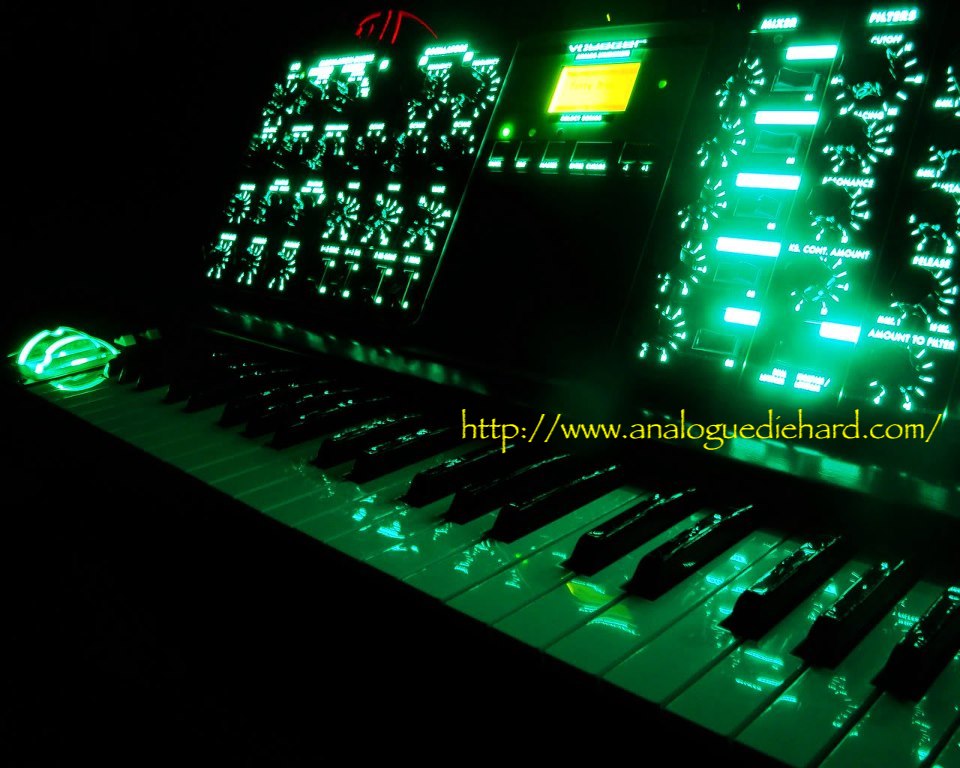
Voyager production started in late 2002. The first 600 Voyagers were $3495 Signature Editions (initially $2995), with blue backlight clear pitch/mod wheels; wood cases available in walnut, cherry, or maple; brass badge to the right above the keyboard. They all sold out in less than a year. Then the standard $2995 production models throughout the lifecycle were "Performer" models with walnut stained oak cases. Performer models could add the blue backlit clear pitch/mod wheels for $159. Panel backlighting option using electroluminescent technology was first offered in 2004. The backlight could be dimmed.

Moog offered various limited special editions such as the "Select Series" with varying options of woods (mahogany, electric blue, traditional ash, white wash, maple, black, cherry, walnut), finishes on the woods, and various colors (red, blue, white, orange, green, purple) for the backlight. Customers could order any permutation of woods and backlighting. There was also the "Electric Blue" (black wood finish with blue backlight) and "Lunar Series" with backlight colors in the spirit of space travel (see the image at top in the middle row). The Voyager was also offered in stunning whitewash wood finishes with white rocker switches and white backlight, and an "Aluminum Edition" with aluminum case and light blue backlight. Other limited editions were the 50th Anniversary Edition (to celebrate 50 years of Moog Music) with the commemorative coin embedded in one of the case endpieces, and 31 units of the $15,000 (eek!) 10th Anniversary Edition Voyager were built in 2013 with a gold plated panel, the wood case finished in black lacquer with scrolling Japanese Awabi Pearl inlays in the sides, and translucent control knobs (Sweetwater has one). All of the special editions were electronically identical to the standard Voyager.

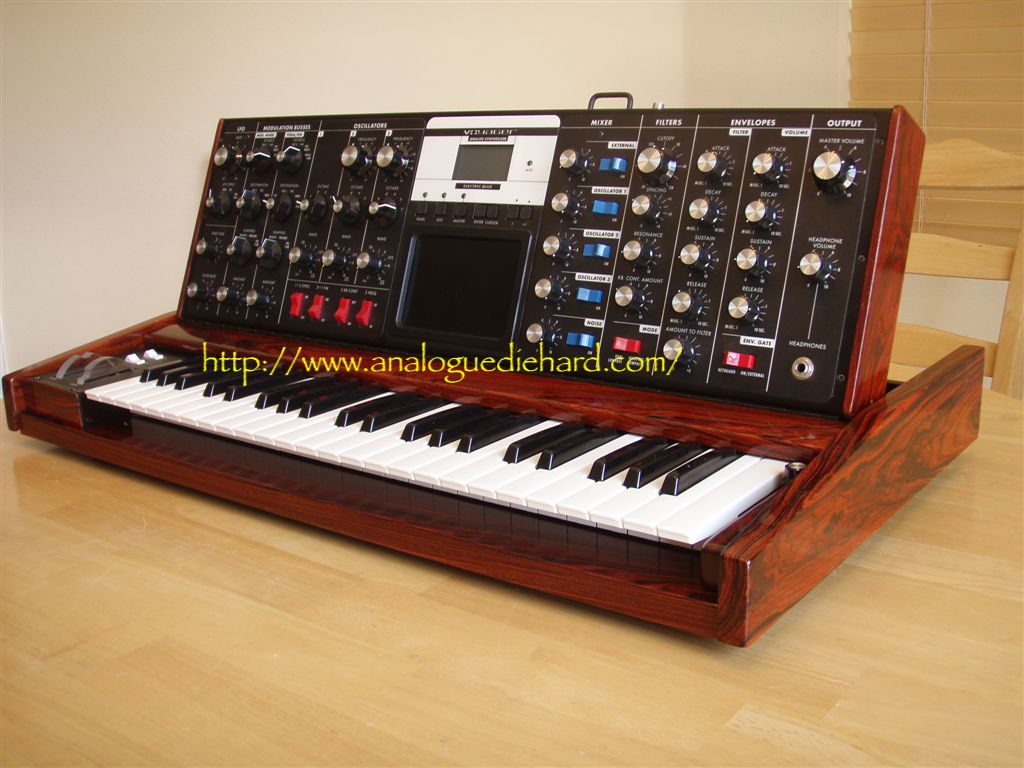
One of my favorite limited edition Voyagers is the one built with a rosewood case, seen at the top of this page in the top row of images 2nd from the right. I don't remember Moog Music offering rosewood; the grain of rosewood is colorful and classy, but it is a rare wood that is near extinction.

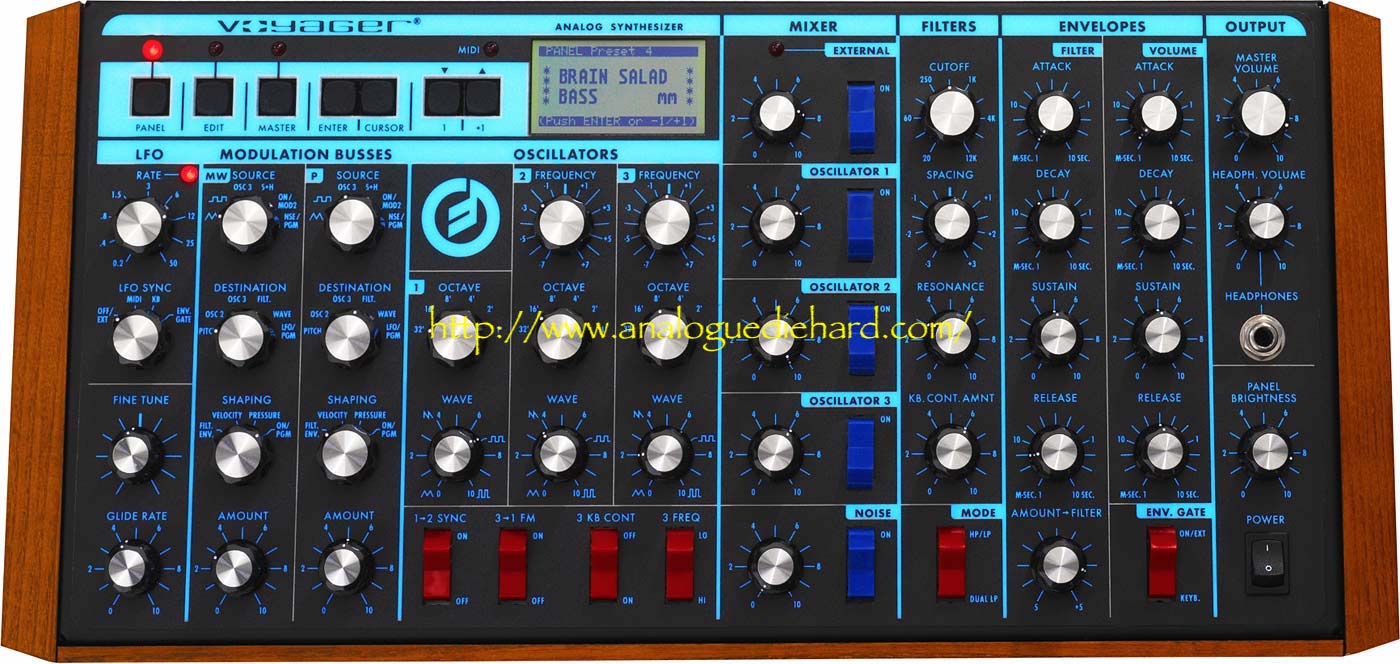
Moog Music introduced the RME model (Rack Mounted Edition) in 2005 which is a compact module without keyboard or touch surface, and the control panel size reduced to fit a 19 inch rack ("Honey I shrunk the Voyager!"). The RME had the backlighted panel and could also serve as a tabletop module. Other than the omitted keyboard, touch surface, and I/O jacks on the rear panel the RME was identical to the standard Voyager.

Options such as the VX-351 accessory extended the CV outputs of the Voyager for interfacing with external modulars. The VX-351 requires a cable with DB25 connectors and a small circuit board to install in the Voyager. The CP-251 Control Processor module was initially targetted to the Moogerfooger pedal line but was applicable to the Voyager. The CP-251 and VX-351 could be rackmounted using an optional kit. The RME could also use the VX-351 to expand the outputs, and a VX-352 accessory broke out the CV inputs to the RME. The VX-352 is now hard to find.

The Voyager "Old School" model was a Voyager with the programmable feature, MIDI, and touch surface omitted. It could be controlled from the keyboard or from external CV controllers (sequencers, etc) to its CV/trigger I/O jacks. The analog circuit board containing the synth engine is the same circuit board as the standard Voyager and is reported to sound better without the digital programmer circuitry. The Old School model was produced for only one year from 2008 to 2009.

The Voyager was discontinued in 2015. Starting in 2010 the Voyager XL made its debut. This was an expanded Voyager with 61 note keybed, integrated CP-251/VX-351 accessories, and ribbon controller. The XL was the last of the Voyager models whose production ceased in 2018. The last firmware revision was v3.6 and is still available on Rudi Linhard's website.

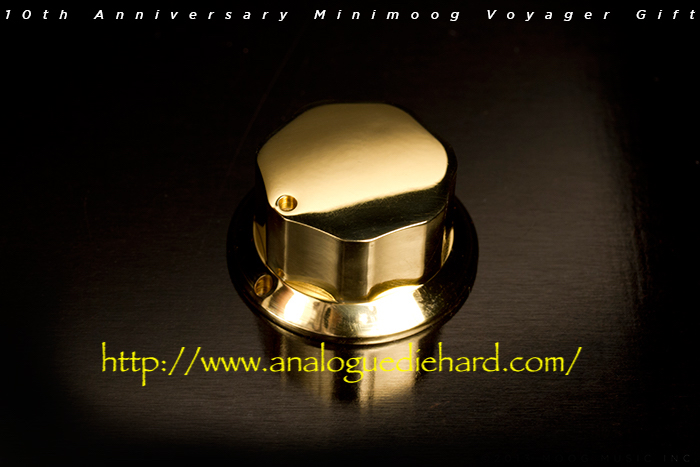
About the year 2015, Moog Music rewarded the loyalty of its early adopters by gifting them with a brass knob. It was a large knob with brass plating, whose image can be seen at the top of this page at the far right in the bottom row. I was the lucky recipient of one, you can see it on the LFO Rate control.

Voyager production was a respectable 15 years, few synthesizers had a production life that long. Over 14,000 total Voyagers were made. Production ended because its technology was obsolete - the original design was built using through hole technology (THT) components, which was fast being replaced with surface mount technology (SMT) components. Besides requiring a complete circuit board redesign to use SMT parts, key components were no longer available and the man who knew how the Voyager ticked had passed away in 2007. top

Epilogue

The Voyager isn't for everybody, no one synth is. If you look at the price and start wishing that it had a sequencer or arpeggiator or built-in effects or polyphony, then you don't understand the potential of this machine. This is a synth designed for players, with expressive tools and a great sound meant to be played and shaped with human hands. The Voyager is designed to be an "instrument", much like the human voice, the trumpet, the saxophone, the violin, or any other organic instrument. Oh it can easily produce alien sounds too. Don't expect the instant groovebox gratification with the Voyager - you can get cool sounds right away, and learning to get the expressive qualities will take good old fashioned "practice". Same with the trumpet, the sax, the violin. Good wine doesn't happen overnight, and neither does mastery of an instrument.

The Voyager is the only synth I have laid down cold hard cash sight unseen - I had no question that Bob Moog could deliver, and he did. I later ordered the companion VX-351 accessory along with a CP-251. When I unpacked the VX-351 I found that the serial number was the same as my Voyager! Some years later I told the folks at Moog Music about the serial number and they admitted that it was pure coincidence in that serial numbers are randomly packaged to customers. top

contact info

Home